PART 1
Authenticity & provenance
What does the certificate of authenticity contain?
The certificate identifies the artist, title, year, medium, image and paper dimensions, edition number and total edition, signature location, issue date and the issuing gallery. The final certificate is supplied with the work; ask to review a redacted specimen before committing.
Who issues and signs the certificate?
Studio 54 Fine Art coordinates the acquisition and will confirm in writing who issues and signs the certificate for the specific work before an invoice is raised. No buyer should rely on an unsigned generic document.
How does the edition register work?
The gallery confirms the available edition number and records the buyer and certificate against that number. The total edition and any artist’s proofs must be confirmed work by work; neither is assumed from another photograph in the collection.
How can I independently verify the artist?
You can compare the artist’s biography and exhibition history with his original website and the Studio 54 Fine Art, Artsy and Artnet records. Ask the gallery for the direct record for the work you are considering.
Details redacted · available on request
Sigitas Baltramaitis is a Lithuanian-born fine-art photographer who lives and works in Germany. This site is presented by Studio 54 Fine Art. Gallery legal entity, registration number, postal address and telephone must be confirmed before publication.
PART 2
Materials, condition & longevity
How is this work made?
The exact capture method, paper, ink system, mounting, glazing, signature method and edition practice are confirmed for each photograph before sale. No specific production process, including digital or AI-assisted tools, is claimed here until the artist and gallery have documented it.
How long should a fine-art photograph last?
Longevity depends on the named paper, ink, glazing and display environment, so the gallery will not publish a lifespan without a manufacturer-supported specification. Keep any photograph away from direct sunlight, radiators, damp walls and rapid changes in temperature or humidity.
What is the difference between an original, a limited edition and an open print?
An original photograph is the artist-authorised physical work. A limited edition has a declared maximum number of impressions; an open print has no fixed total. The edition statement, artist’s proofs and signature location should appear consistently on the invoice and certificate.
Will I receive a condition report?
A current condition note should be supplied before purchase and a fuller report can be requested for significant works. Any restoration, retouching, replacement frame or material change must be disclosed in writing rather than hidden behind general terms such as “good condition.”
PART 3
Price, and how it is set
What determines the price of a limited-edition photograph?
Price may reflect dimensions, production and framing cost, edition size, position in the edition run, scarcity, and the artist’s documented exhibition or secondary-market record. Studio 54 Fine Art confirms the price and available edition in writing for the individual work.
No verified collection-wide price band was provided for publication. Enquiring is free, private and carries no obligation. An enquiry does not add you to a mailing list.
Can I pay in stages?
Payment currency, deposit, balance date and any staged-payment arrangement are agreed in writing before purchase. Ask for the complete invoice terms and delivered estimate; no general instalment promise is made on this page.
Does a secondary market guarantee future value?
No. Exhibition or auction records can provide context, but they do not promise appreciation, liquidity or a future buyer. Acquire a work because the photograph, documentation, condition, scale and price are right for you.
PART 4
Will it fit? Choosing scale
How large should a photograph be above a sofa?
As a starting point, make the framed work roughly two-thirds to three-quarters of the furniture width, then test it at scale. A common centre line is about 145–150 cm from the floor, adjusted for seating, architecture and the work’s proportions.
How far away should I stand to view it?
A useful first check is a viewing distance around one-and-a-half to two times the framed width. Large works also need closer inspection, so leave enough circulation space to experience both the full composition and surface detail.
What dimensions will I receive?
The quotation should distinguish image size from paper size and framed size, in centimetres and inches, and give the finished weight. It should also name the glazing, because acrylic face-mounts and reflective glazing behave differently under spotlights and windows.
COMPLIMENTARY SCALE STUDY
See the work in your space.
Send a straight-on photograph of your wall with one reliable measurement. We will return a to-scale visualisation once the gallery confirms its response-time commitment. Free, and with no obligation.
Send a wall photograph →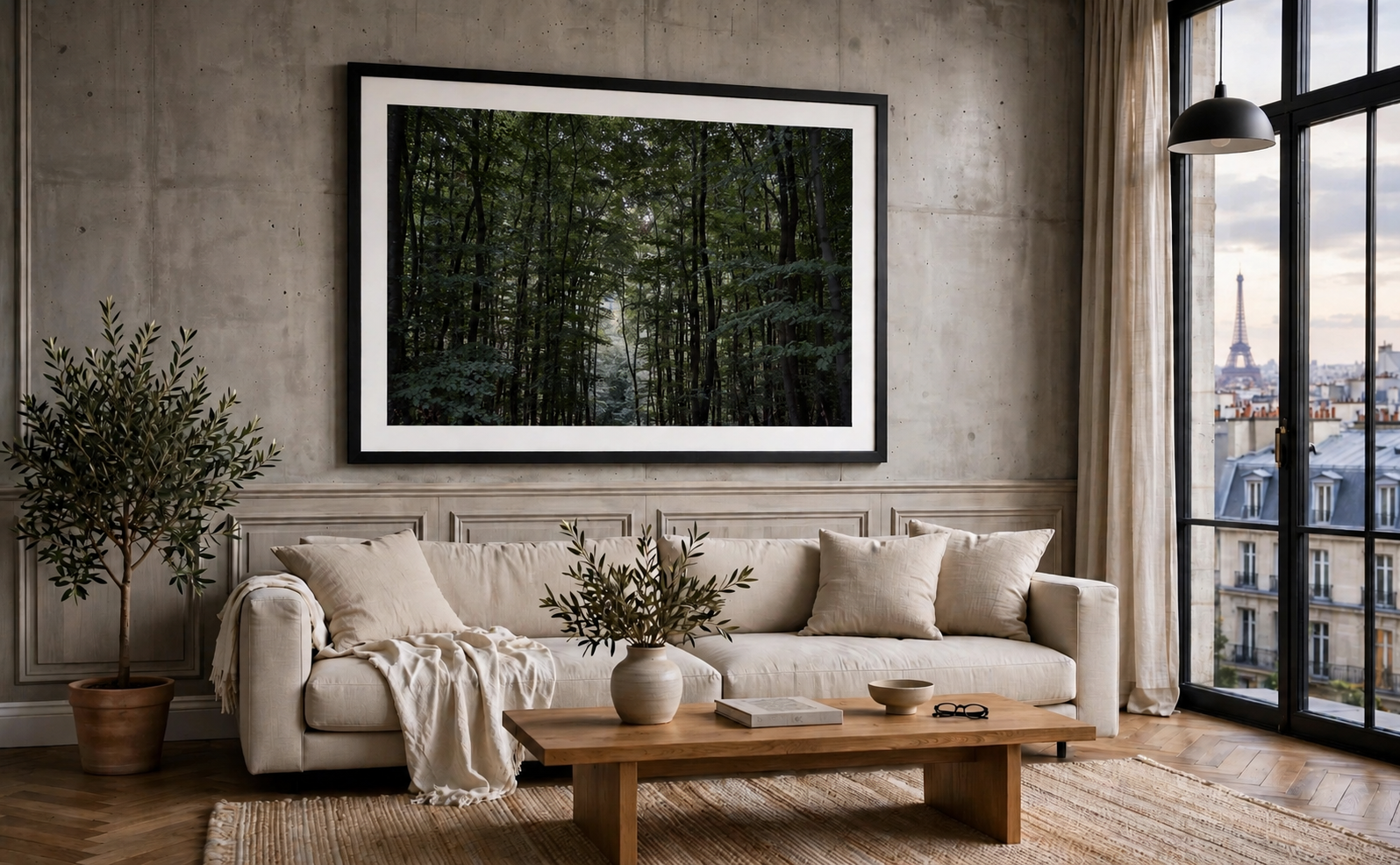
PART 5
Copyright & what you own
Do I own the copyright when I buy a photograph?
You own the physical artwork; the artist retains copyright and reproduction rights. You may display it privately or publicly, lend it to an exhibition, resell it, and photograph it for insurance records and ordinary personal use.
What requires the artist’s written permission?
Commercial reproduction, advertising, merchandise, publication beyond fair personal documentation, and any NFT or digital minting require prior written permission. Ownership of the object does not transfer the right to reproduce the image commercially.
PART 6
Shipping, insurance, customs & returns
How will the artwork be packed and insured?
Studio 54 Fine Art coordinates professional packing and white-glove delivery where available. The crate construction, courier, insurance provider, insured value and delivery estimate must be stated on the individual quotation before you pay.
Who pays customs duty and import VAT?
The responsible party and estimated charges depend on the dispatch point, destination and agreed delivery terms. For Germany, the wider EU, UK, UAE and USA, ask for a destination-specific delivered estimate; do not assume duties or tax are included.
Can I return the artwork?
The gallery’s returns policy has not been supplied for publication. Request the applicable cancellation and return terms in writing before payment, including deadlines, condition requirements, insurance and responsibility for return carriage.
Can the gallery help if I later wish to resell?
Future resale or consignment assistance is not guaranteed. The gallery can confirm whether it is willing to review the work at that time, but cannot promise acceptance, timing, price or a buyer.
PART 7
What happens when you enquire
1 Tell us the work and question, using only your name and email where possible.
2 The gallery confirms price, availability, edition, specification and condition.
3 If useful, we prepare a scale visualisation and destination-specific delivery estimate.
4 You decide without pressure; nothing is reserved or charged without written agreement.
The gallery must confirm its reply-time promise. Every enquiry is private, free and carries no obligation.
Choose an enquiry option →